[One Month Free]Kick Off the New Year With a Free Month of Data Science in Action

A new year always brings that familiar mix of ambition and overwhelm. We set goals, sketch plans, and commit to finally learn the things we’ve been putting off. If leveling up your data science skills is on your list for 2026, I’ve got something special to help you start strong.

Today, I’m opening up a one‑month free trial to my Substack publication:

👉 https://datascienceinaction.substack.com/newyearoffer

It’s the perfect moment to jump in.

I have been teaching and using my writing to teach people my whole life. I teach technically and academically. My goal is to simplify complex concepts by translating them into real-world applications through step-by-step tutorials.

What is Data Science In Action?

Data Science in Action is a hands-on newsletter that helps you master analytics, coding, and the modern data stack.

Through practical tutorials and articles in SAS, Python, Docker, Kubernetes, data visualization, and data storytelling, you’ll learn by building — not just reading. You might also find me writing political and financial data stories.

Whether you’re sharpening your skills or scaling up to production-ready workflows, this space is designed to turn complex concepts into actionable steps you can apply right away.

Who is this for?

It is for beginners and intermediate data scientists, data analysts, and DevOps professionals. All tutorials, regardless of their level, will cover the concepts with step-by-step instructions, screenshots, and explanations. They will also be easy to follow, self-contained, and compact.

What can subscribers expect?

  • Free posts: approachable tutorials, storytelling techniques, and examples you can run instantly.
  • Paid posts: deep dives into Docker, Kubernetes, Python, reproducible analytics, and enterprise-grade SAS workflows.
  • Occasional excerpts from my books, plus behind-the-scenes insights into how I teach and build real-world solutions.
  • Community input: I’ll regularly ask for your challenges and questions — and turn them into future posts. Feel free to share your challenges, and I’ll do my best to help you resolve them.

Subscribe to get full access to the newsletter and publication archives.

More about me

I am an Adjunct Lecturer and an author for Apress and Packt Publishing, having published nine books and currently writing my 10th. All of them are best sellers on Amazon.

Currently, I teach SAS Fundamentals, SAS Programming Intermediate (Test-Prep for the SAS Associate and SAS Specialist Certificates), SAS SQL, SAS Macros, SAS Advanced Programming, Docker Fundamentals, Docker for Enterprise Developers, Kubernetes Introduction, Kubernetes Intermediate, Docker Certified Associate (DCA) Test Prep, Introduction to Python, Python for Data Science, Technical Writing at ONLC (Microsoft Partner), Plurasight Inc., and other venues as a freelance instructor.

I hold two master’s degrees: one in journalism from Harvard University’s Extension School (Data Science Graduate Professional Certificate) and another in computer engineering from Cairo University.

I am the author and co-author of the following books:

  1. Learn Data Science Using SAS Studio (2nd Edition), From Clicks To Code, Apress Springer Nature
  2. Learn Data Science Using Python, Apress Springer Nature
  3. A Complete Guide to Docker for Operations and Development, Test-Prep for the Docker Certified Associate (DCA) Exam, Apress Springer Nature
  4. Learn Data Science Using SAS Studio: A Quick-Start Guide, First Edition, Apress Springer Nature
  5. The Docker Workshop, Packt Publishing
  6. Tales about Love and Travel, Arabic Edition, Dar Laila
  7. Mn Europa El Balad, Arabic Edition, Dar Laila
  8. Tales from Dreams, Arabic Edition, Dar Dawen
  9. The Girl and the Butterfly, English Edition, Self-Published
  10. The Girl and the Butterfly, Arabic Edition, Self-Published

I am proud to have written the first eight books before AI became so creative! 😉

My Data Science Book with Apress Springer Nature is finally available

Thanks to Allah!
Learn Data Science Using SAS Studio: A Quick-Start Guide
(Published By Apress Springer Nature)
You can buy it at:
Paper copy at Amazon.com
https://amzn.to/3lh00JU
Digital copy at Kindle Store:
https://amzn.to/3d44DEf

Do you want to create data analysis reports without writing a line of code? This book introduces SAS Studio, a free data science web browser-based product for educational and non-commercial purposes. The power of SAS Studio comes from its visual point-and-click user interface that generates SAS code. It is easier to learn SAS Studio than to learn R and Python to accomplish data cleaning, statistics, and visualization tasks.

The book includes a case study about analyzing the data required for predicting the results of presidential elections in the state of Maine for 2016 and 2020. In addition to the presidential elections, the book provides real-life examples, including analyzing stocks, oil and gold prices, crime, marketing, and healthcare. You will see data science in action and how easy it is to perform complicated tasks and visualizations in SAS Studio.

You will learn, step-by-step, how to do visualizations, including maps. In most cases, you will not need a line of code as you work with the SAS Studio graphical user interface. The book includes explanations of the code that SAS Studio generates automatically. You will learn how to edit this code to perform more complicated advanced tasks. The book introduces you to multiple SAS products such as SAS Viya, SAS Analytics, and SAS Visual Statistics.

You will:

Become familiar with SAS Studio IDE
Understand essential visualizations
Know the fundamental statistical analysis required in most data science and analytics reports
Clean the most common data set problems
Use linear progression for data prediction
Write programs in SAS
Get introduced to SAS-Viya, which is more potent than SAS Studio

#ad #paidlink
My piece at Harvard Extension School Paper: A FATHER AND SON’S STORY IN SCIENCE STORYTELLING: VIROL VLOG

http://www.hesponline.com/a-father-and-sons-story-in-science-storytelling-virol-vlog-engy-fouda/

Virol Vlog new logo 

A father and son’s story in science storytelling: Virol Vlog 

HOPEWELL JUNCTION, N.Y. — The father gets ready to shoot a new video in the house basement with a green background behind him.  

His son hardly reaches the camera holding the clapboard and says, “EBOLA. Take four. Action.” Then he claps it.  

Islam Hussein, an American-Egyptian virologist and scientist at Massachusetts Institute of Technology, and his middle-school son, Adham Hussein, have a YouTube channel called Virol Vlog.  

Hussein said the name is composed of two parts. The first part, Virol, stands for Virology, and the second part, Vlog, stands for Video blog.  

Adham said, “In this world, we try to input what we can do to make it a better place. I feel that we are adding when one person learns from our videos and correct his knowledge.” 

They counterattack how the unprofessional media mishandle the science of viruses, Hussein said. They present an alternative channel by producing funny short videos for the general public.  

Moreover, they contribute to the Arabic content on the web where only 3 percent of the internet content is in Arabic, according to a report published by the UNESCO.   

Adham said when he grows up, he wants to pursue a filmmaking degree, then another degree in any other technical field.  

Hussein laughed and said that Adham will take a degree in engineering first then in filmmaking.  

Adham said that he is still young, and they can discuss this issue later. 

The start 

Hussein said that the spark to produce these videos was on Feb. 22, 2014. He said he was shocked by an announcement made by the official spokesman of the Egyptian Armed Forces claiming that they invented new devices for treating HIV and hepatitis C patients.  

The media in Egypt produced propaganda that these devices can cure all viral infections.   

Major General Ibrahim AbdulAtti, the inventor of these devices, said on the national television that his cure could turn viruses of the infected patients into a kofta kabob. 

“Outrageous claims that AbdulAtti clinic can cure AIDS with ground beef kabob,” Hussein said. He posted a video on YouTube to prove Major AbdulAtti’s false claims.  

The video went viral.  

The process  

Hussein said, “I deal with these videos as if I am publishing a scientific paper.” He said that he takes much time to generate the ideas and research them.  

Then he writes a script. “I try to live it. If I have to give a particular facial expression, I digest it like a small acting scene,” Hussein said. 

Afterward, Hussein and Adham go to their house basement to shoot the video and the audio multiple times. Hussein said the shooting of a 15-minute video might take a day or at least half a day. 

Adham said they shoot the scene 10 or 20 times till they are satisfied with the quality. “We are both very stubborn, and we want the best,” he said. 

 
Hussein said that their learning curve was painful as they started without any experience in filmmaking or video editing. They learned by trial and error, YouTube tutorial videos, Udemy and Lynda courses.  

As any academic researcher, Hussein initially recorded the first video as a PowerPoint presentation along with the audio.  

“People hated it,” Hussein said. 

Their scientific videos comprise humor with virus puppets and funny shots  

Consequently, Hussein said they revamped the video style by buying a studio umbrella lighting with a green screen background, camera and some virus puppets. Then they shoot Hussein explaining.  

Finally, they comprise humor to the scientific videos with demonstrating diagrams and some fun shots from related Arabic movies.  

Nevertheless, Hussein said the audio was terrible.  

With experience, they now record the audio with two mics independent from the video and sync them later in the editing, he said.  

Hussein said that he keeps a log of any comment that he finds useful whether negative or positive in Evernote. Adham never knew that.  

Adham said, “He keeps things from me!”  

They laughed. 

It takes about a week after shooting to edit, render and upload the video to YouTube, Hussein said.  

Funding 

The main challenge they face is the funding as the devices are expensive, Hussein said.  

Last year, they ran an Indiegogo crowd funding campaign. It enabled them to buy a new computer instead of the 5-year-old laptop that used to take extended time in rendering videos, a new camera and mic, Hussein said. 

He said, “The Indiegogo campaign still accepts money. However, we seek a sponsor.” 

Currently, they rely on their fans and peers to fund them monthly as their patrons

Future plans 

Hussein said if they have enough funding, they will produce scientific videos for children. Kids videos need a myriad of animation which is a high cost. Moreover, they plan to produce videos in English and to add English captions to their Arabic videos.  

“The problem with Arabic is that our videos have cultural inferences and jokes,” Hussein said. 

Unless they hire professional translators, the captions will be gibberish. According to Unbabel, a prominent company that develops an artificial intelligence powered human translations, Arabic is the second toughest language to translate to English.  

Hussein said he wishes to have a working group to brainstorm ideas with, and to be able to produce regular videos. However, Adham said that they are a team of two, and it works well.  

“I am glad to be part of something bigger than just being myself and help in educating people,” Adham said. 

Father-son relationship 

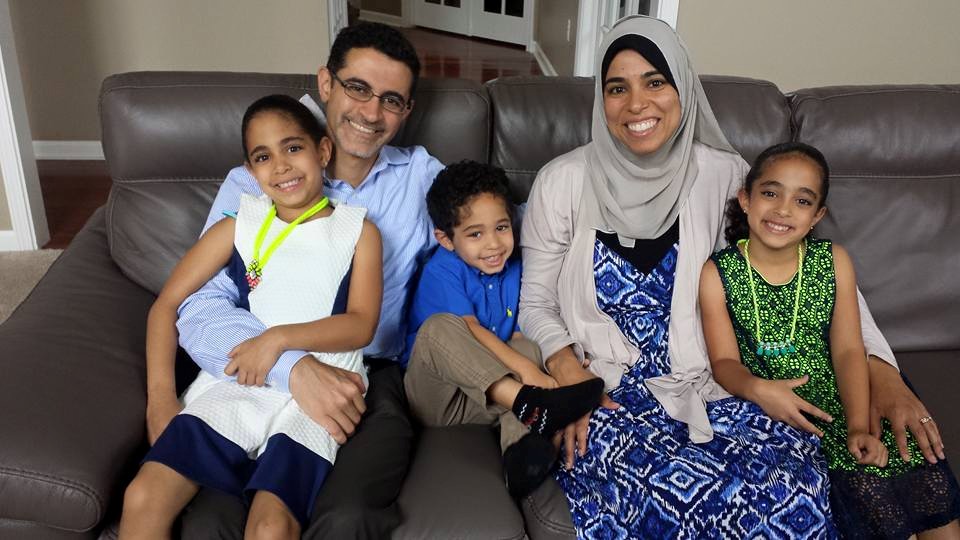
From left to right: Reem Hussein, Randa Azab, Islam Hussein and Adham 

In response to their father-son relationship, Hussein said the Virol Vlog added to their relationship.  

However, he said that in this initiative, he works with Adham as his partner not his son. Hence, he relies on Adham in learning any new technical skill; then Adham teaches it to him.  

“It brought us much closer as a family. For example, I can criticize him,” Adham said with a laugh and said, “For example, about the funny references, I provide input as I can.” 

Adham said, “My older sister, Reem, and Mama put immense input, comments and critique.” Besides, at times, his sister helped in shooting by being behind the camera. 

Randa Azab, Hussein’s wife and Adham’s mother, said that Islam always shares his knowledge. Azab and Hussein were peers in the same class at the veterinary medicine faculty. 

“Our love was at the morgue,” she said.  

Her first day was at the morgue. She said formalin scent was vehement that blurred her eyes. Then she saw Hussein holding a horse leg and explaining its anatomy to his peers.   

“It takes a lot of work. They don’t profit from it. People don’t realize how much work and money that goes into producing [the Virol Vlog videos],” Reem Hussein said. 

My new article at Harvard Extension Student Paper: ZAMIR HASSAN: MUSLIMS AGAINST HUNGER

http://www.hesponline.com/zamir-hassan-muslims-against-hunger-engy-fouda/

Zamir Hassan: Muslims Against Hunger 

A software engineer combats America’s hunger crisis 

By Engy Fouda 

Zamir Hassan’s story about combating hunger started in 2000 when he chaperoned his son’s school to a soup kitchen in a wealthy neighborhood in New Jersey close to his house. On that day, he and the other volunteers fed more than two hundred people. “There are hungry people around me, and I don’t even know that they are here. As a Muslim, I am not supposed to go to bed if my neighbor is hungry. I started reflecting on that, what kind of Muslim I am?!” said Hassan, the founder of Muslims Against Hunger in a hotel room in Washington D.C. via Skype interview.  

Hassan is a retired software engineer who grew up in Pakistan and moved to the U.S. in 1973. He studied at Cornell University, lived in New York, and currently lives in New Jersey. “I was in IT [Information Technology] before there was IT. So, I had a good life, as I did well financially,” said Hassan with a smile in retrospect. Since the soup kitchen day, he has dedicated his life to counter hunger in the U.S. 

Hassan said that the name of the “soup kitchen” historically was formed when a Christian person asked everybody to bring food for charity. Everybody brought different dishes. To serve everybody equally, he decided to cook all the food together in a big pot and to serve it as soup.  Similarly, the food choices caused a dilemma when Hassan and his friends decided to make a soup kitchen at their mosque. His friends proposed cooking pizza, spaghetti, and Italian food. Hassan objected that idea because at their houses they eat tandoori chicken, samosa, baklava, and other oriental dishes. He told them that Muslims should share from food that they themselves eat at their houses. He assured in a firm voice, “As a Muslim, I am supposed to feed people from my own plate. We practice our religion, but we don’t live it. To live it every day, we feed people from what we eat.” Now, their soup kitchen serves various cuisines depending upon what the volunteer cooks eat at their houses.  

Albeit charity is a pillar of Islam, the shortage of volunteers to help in the soup kitchen always challenges Hassan. Hence, he used to trick his friends by inviting them over to his house. After they arrived, he would ask them to come with him on an urgent short trip. To their surprise, he would drive them to the soup kitchen to cook and serve. When they finished volunteering, he drove them back to his home for an oriental dinner. The experience of volunteering at the soup kitchen usually enraptured his friends; hence, they would ask him to invite them again to help. “My goal is to engage Muslims in their communities. I want to change their mindset. They have to live their religion, not only practicing it,” said Hassan. His position is that Islam is not merely about rituals and building mosques but about daily charity – similar to the Muslim’s five daily prayers. He based his opinion on the continuous pairing of the prayer with charity in the Quran. Therefore, he founded various programs to fight hunger. 

In 2011, Hassan started the “Hunger Van” program, a mobile version of the soup kitchen. The program is designed to reach the needy instead of waiting them to come to the soup kitchen. Accordingly, the local volunteers register on the Hunger Van website, and Hassan drives the van to them where he teaches them how to prepare his sandwiches. Hassan makes two types of sandwiches which he calls them honey bee sandwich and peace sandwich.  

The honey bee sandwich, he spreads honey on one bread slice with a cinnamon sprinkle, the other slice has peanut butter, and in between a sliced banana. While the peace sandwich is hummus on the two slices with salad in between. In winter, he and the volunteers make both sandwiches, but in summer, they make the honey bee only because hummus goes bad fast. Then, they drive the van to the local areas where the volunteers know that there are homeless people and hand them the sandwiches. “Last year, we distributed 30,000 meals. A hundred and fifty meals came from Non-Muslims: churches, synagogues, and Hindu temples. In 2016, we participated in 9/11 event and sponsored making 500,000 meals on the day of 9/11,” added Hassan.  

Because other religions stepped up, Hassan expanded Muslims Against Hunger and initiated Faith Against Hunger, an interfaith program for combating hunger. “Hunger has no religion,” he said. He criticized how some Muslims were reluctant to collaborate with other religions. He spreads the interfaith message not only with food; last year, a Hindu Sunday School in New Jersey invited him to teach a class about charity. In addition to the paucity of the volunteers, he struggles with the funding and endures from politics. 

For instance, on the following day of Paris attacks, on 16th November 2015, Hassan had a Hunger Van event in Boston with some local volunteers. One of the homeless people shouted at a veiled lady from the volunteers questioning her if there was poison in the sandwiches. As she was a psychiatrist, she laughed despite of her surprise and engaged him in a conversation. She allayed his fears by replying that she could take a bite from the sandwich, which convinced him to try the sandwiches.  After few minutes, the incident was repeated with another homeless person who after calming down asked about the origins of the sandwiches. Hence, they decided naming the hummus sandwich as the peace sandwich as both the Arabs and the Jews claim that that hummus is theirs, but they do not fight over it. 

On the other hand, Tarek Sharaf, a Muslim who volunteers with Hassan, said that he has never experienced any negative situations similar to the one in Boston. On the contrary, he has always experienced appreciation and thankfulness. Sharaf also organizes a soup kitchen at his local mosque on a monthly basis. “Brother Zamir does amazing work,” he said. “I think that this what Muslims need, especially, nowadays considering the current environment.” Sharaf bolsters Hassan’s perspective about practicing the religion’s beliefs through action instead of preaching, especially for young Muslims who have shown a commitment to community service, “They really enjoy making a difference,” he said. “I always remind them [young Muslims] that the Prophet had a daily soup kitchen feeding 70 poor people every day.” He added that Muslims Against Hunger was an innovative, unique project when it started, but now there are myriad projects similar to it.  

For instance, Sharaf volunteers at a Pious Projects America Organization, a nonprofit charitable organization that links projects with donors in the U.S. and Canada. Pious Projects of America mission as stated on its website, “ [it] created a way for people to take part in humanitarian charitable projects from all over the world. It partnered up with the best charitable organizations and developed a crowdfunding platform for people to donate to as many causes that they feel are important all under one place.” In December, they handed the homeless people in New Jersey a “winter kit” containing a pair of gloves, a blanket, a pair of socks, a hat, and a snack. Alas in the U.S., the homelessness, hunger, and poverty rates are high even though there are enormous of such projects. 

  According to Do Something Organization, fifty-four million people suffer hunger in the U.S. Sarcastically, the organization states that 40 percent of food is thrown out in the U.S. every year. Hassan defines hunger similar to the United States Department of Agriculture definition of hunger or food insecurity as “the lack of access, at times, to enough food for all household members.”   

To continue his advocacy efforts, Hassan travels across the states with his Hunger Van to teach people how to set up a soup kitchen. He wishes to establish a soup kitchen at every mosque, and for every Muslim to practice charity by feeding others on a daily basis. While tapping his fingers on the table, he concluded, “It is about time that we walk the talk. Stop talking. Walk the talk.” 

Free your mind and watch the new you!

Tae
There are many stories behind this picture.

Last August, I received “Best Skills Award” at my Taekwondo School. I recovered from two fractures in my right foot before that picture, by a couple of months.

Before the test by few days, I fell because of my foot while training.

At that time, I felt that it was over and I told myself, “Respect our age, and quit it, that is enough.”

My Master came to me and told me, “Your strength is in your mind and in what you say to yourself. If your mind can visualize yourself doing the move, your body will do it. Your body has no choice, it must follow your mind’s orders. You, who manipulate your mind and direct it by what you say to yourself. Tell yourself that you can do it and you will do it. “

I said these advices to the kids in my speech after receiving the award in the small picture in the corner. I said, “Believe that you can. Make your mind visualize it. Your body will follow.
Three steps which easy to say, but need much practice to achieve.”

I applied these steps in the sparring part of the belt test. They gave me the award because of my unexpected kicks in the sparring part. No one knew that I had to do those unexpected kicks because of my foot pain. My foot started to turn red, hot and swollen. All my focus was to avoid balancing on the fractured parts.
Indeed the success is only from Allah.

Taekwondo to me is physical therapy. I had a problem in my knee that made me not able to walk for some times or use a stick. The doctor gave me medications. After I finished my physical therapy, he said that if I ever stopped playing sports, I would repeat that course again. He added that if I want to be able to walk then I have to walk. I remembered at that time, Prophet’s Mohamed telling us that knowledge can be achieved by learning and being tolerant can be achieved by being tolerant.

Frankly, Taekwondo is psychological therapy, too.
I had a bad depression. It was worse than any physical illness.
In Taekwondo, I kick, hit, break wood boards, scream and do the energy exercises.

First day in Taekwondo, I was so embarrassed and was telling myself that I am too old to start anything. But I found that I was the youngest in the class.

Many of my daughter’s friends’ families stayed to cheer for me on my test. Everybody was encouraging me to stay persistent. Nobody was aware of the fight I had with my culture and my thoughts.

Conclusion: You can do whatever you want under whatever circumstances.
Allah created your mind free with extraordinary powers.
You who limit your mind and imprison it. Your body consequently will follow because the body has to follow the mind’s orders and has no other choice.
Free your mind and watch the new you!

Forget the people and do what you want.
Life is short and it is only a test.
The real life is the hereafter.
So purify the intentions.

Peace be upon you